The most expensive error in machining is not a scrapped cut; it is a feature that is right in itself and wrong relative to everything else. A hole can be dead-on its own drawing position and still miss the pocket on the opposite face by enough to scrap the part, because the two features were located from two different clamps. Five-axis single-setup machining removes that failure mode at the source: the part stays in one fixture while the machine indexes around it, so every face is generated from the same physical origin. This guide explains what single setup actually buys you, why the tolerance gain is real and where it comes from, and the honest cases where one setup is a waste of spindle time.
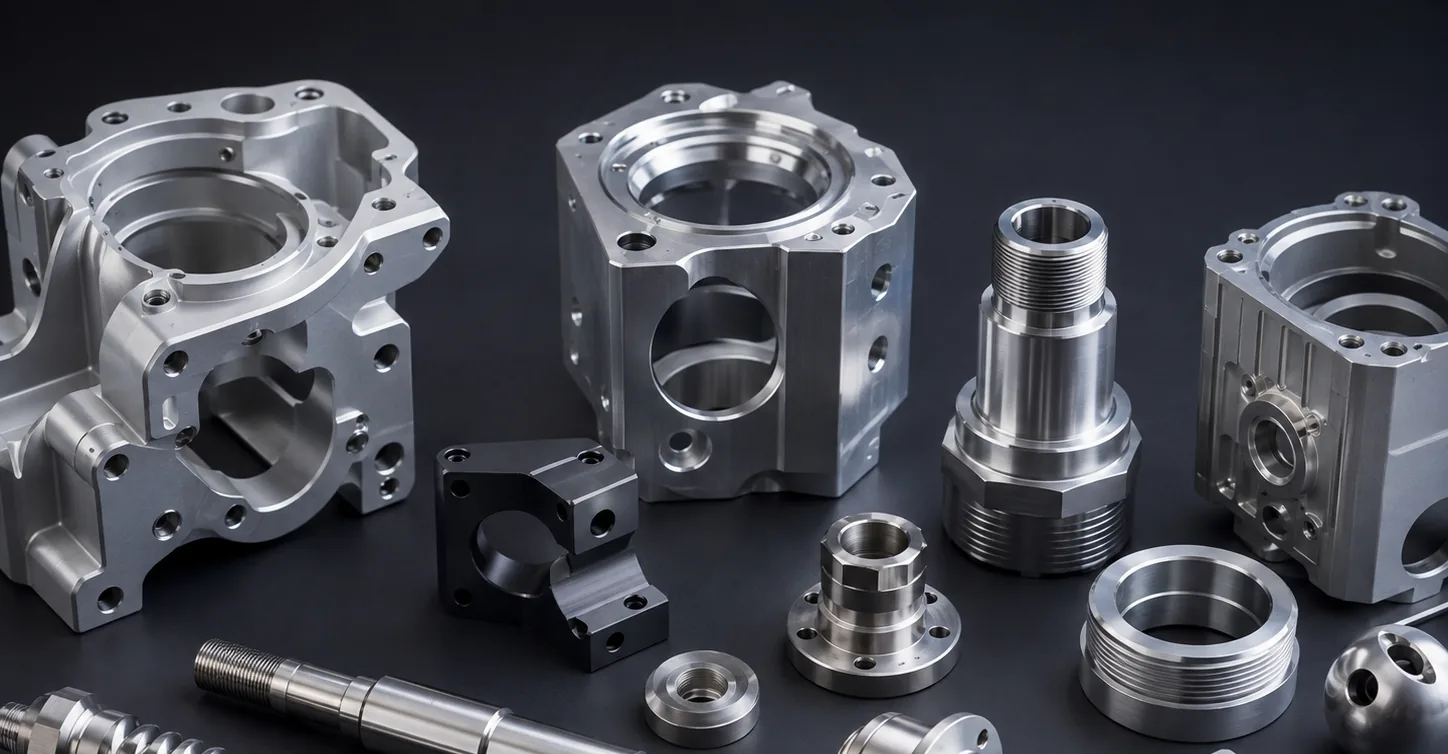
Where stacking error comes from
Every time a part is unclamped and clamped again, its relationship to the machine's coordinate system is re-established from scratch. A three-axis part with features on three faces runs through three setups, and each setup introduces a locating uncertainty: how accurately the fixture seats the part, how flat the datum faces sit, and how precisely the operator or probe re-zeroes the work offset. These errors do not cancel out; they stack. The hole on face A is located from setup one, the pocket on face B from setup two, and the difference between them now carries both locating errors plus the machine's own positioning error, twice over.
This is the datum drift that designers complain about without naming. A drawing calls out a true position from one datum reference frame, but the part was never machined from a single frame — it was machined from three approximations of it. The shop compensates by loosening tolerances, by adding operations to pick up the datum again, or by sorting parts after the fact. All three cost money. The single setup sidesteps the problem because there is no second locating: the spindle orients to the part, not the other way around, and the same physical datum is live for every cut.
What one setup actually does to the numbers
The tolerance gain is not a marketing claim; it is arithmetic. If a shop holds a locating repeatability of a few thousandths of an inch per setup, a feature machined across three setups can carry three times that uncertainty between its critical faces before a single tool even touches metal. Remove two of those setups and the cross-feature error drops to the machine's own positioning and the single locating event. For the parts that live and die by feature-to-feature relationship — a bore that must align with a face on the far side, a datum hole that indexes an entire assembly — that is the difference between a part that assembles and one that fights every bolt.
The second, quieter gain is surface continuity. When adjacent faces are machined in separate setups, the blend between them is wherever the two programs happened to meet, and any mismatch in the blend is a witness line or a step. In a single setup the tool simply walks around the corner, and the transition is as clean as the machine's own motion. For a cosmetic surface that will be anodized, or a sealing face that must sit flat against a mating part, that continuity is worth more than any single tolerance on the print.
| Factor | Multi-setup 3-axis | Single-setup 5-axis |
|---|---|---|
| Feature-to-feature position | Stacks locating error per setup | One locating event, one live datum |
| Blend between adjacent faces | Two programs meet at a line | Tool walks the corner in one path |
| Re-zeroing risk | Re-zeroed every clamp | Zeroed once, then indexed |
| Fixture count | One or more per face | Usually one, plus soft jaws or dovetail |
| Setup labour | Scales with face count | Front-loaded once |
| Cost per part | Lower for simple parts | Pays only past a complexity threshold |
The mechanics of holding a part once
Machining five sides of a part while holding it once is a workholding problem before it is a programming problem. The part must be gripped in a way that leaves the faces you need to cut exposed while keeping the part rigid enough to cut. The common answers are a dovetail prep, a set of soft jaws, or a sacrificial tab machined into the stock that is cut away at the end. Each trades material for access: the dovetail or tab is a deliberate piece of stock that exists only so the machine has something to hold, and it is removed in a final operation that the setup has to plan for from the start.
Because the part is indexed, not re-clamped, the machine's rotary and tilt axes become part of the locating chain. The trunnion or tilting head has its own accuracy, and it has to be good enough that the orientation it commands matches the orientation it delivers. This is where a capable five-axis machine earns its price, and where a worn or cheap one quietly eats the tolerance you thought you were buying. The workholding, the rotary axes, and the probe that verifies the datum all have to be in the same league, or the single setup is a promise the hardware cannot keep.
When one setup is not worth it
Single setup is not a default; it is a tool with a cost, and the cost is front-loaded. The programming is harder, the workholding has to be designed, and a five-axis cycle on a complex part can run slower than three aggressive three-axis setups when the part is simple enough. If the part has features on only one or two faces, or if the cross-feature relationships are loose, a five-axis single setup is spending money to solve a problem the part does not have. The honest test is simple: count the datum relationships that actually matter, and if none of them span more than one face, machine it in three-axis and keep the change.
The other quiet cost is access. Holding a part once to reach five faces almost always means giving up some rigidity, because the part is held on a small prep rather than seated across a full face. A flimsy part indexed on a dovetail will chatter where the same part clamped flat would not, and chatter is a surface finish and tool life problem that a tighter tolerance spec cannot fix. The single setup has to earn its rigidity back through stock, through support, or through a lighter cut, and that is a real, billable tradeoff that gets lost in the brochure talk.
Designing the part for a single setup
The parts that benefit most from one setup are not necessarily the most complex; they are the ones where features on different faces must agree with each other. A housing where two bores on opposite walls must be coaxial, a manifold where a port on the side must land relative to a flange on the back, a bracket where a datum hole locates a face two surfaces away — these are the parts where stacking error is the enemy, and they are exactly the parts a designer can make single-setup friendly. A small dovetail allowance on a non-critical edge, a datum feature that can be probed in the first pass, and a tolerance scheme that references one frame instead of three all move a part toward a clean one-clamp run.
The payoff shows up downstream. A part machined from one datum assembles against its mating part from one datum, and the stack the designer built into the assembly tolerance actually holds. When the mating faces, the bores, and the locating features are all generated in the same frame, the part stops being a collection of individually-correct features and becomes a single, coherent object — which is the whole point of machining it in one grip to begin with.
- Count the real datum relationships first — if no critical feature spans faces, single setup is overspending.
- Plan the workholding before the program — dovetail, soft jaws, or a sacrificial tab all trade material for access.
- Probe the datum in the first pass — verify the part is where the program thinks it is, once.
- Match the rotary axes to the tolerance — the tilt axis is now part of your locating chain.
- Watch rigidity on the prep — a flimsy indexed part chatters where a face-clamped part would not.
- Reference one datum frame on the drawing — three frames on paper fight a single setup on the machine.
- Reserve five-axis for the blend and the bores — rough simple faces in three-axis and save the spindle time.
"Single setup is not a faster way to make the same part; it is a different part. When you re-clamp, you rebuild the part's relationship to the machine every time, and whatever you built the first time is only as good as your second and third locating. When you hold it once, every feature is born from the same origin, and the part finally agrees with itself. The tolerance you gain is not the machine getting better — it is the error you stop adding."
Five-axis single-setup machining earns its price on the parts where features have to agree with each other across faces — the coaxial bores, the datum-located brackets, the housings where a side port must land relative to a back flange. On those parts the value is not speed; it is the disappearance of stacking error, a cleaner blend, and a part that assembles from the same frame it was machined from. On a simple part with loose relationships, it is money spent for nothing. The skill is knowing which part you are holding before you decide how many times to let go of it.
If you have a part where features across faces have to land relative to each other — coaxial bores, a datum-located housing, or a bracket with a face-to-face true position — send the drawing over and we will tell you straight whether a single-setup five-axis run is worth it for this geometry, or whether it should stay on three-axis and keep the cost down.