CNC lead time is rarely killed by one big delay. It leaks away in a dozen small places — a non-standard hole that needs a special reamer, a tolerance that forces a second setup, an anodizing slot that was never booked, a stock order placed after the program was already written. Most of those leaks are decided before the first spindle turns, and most of them can be closed without paying a single rush fee. This guide walks through the design, scheduling, and process moves that compress CNC turnaround time on real 6061-T6 aluminum work, drawn from how parts actually flow through a job shop rather than from a textbook.
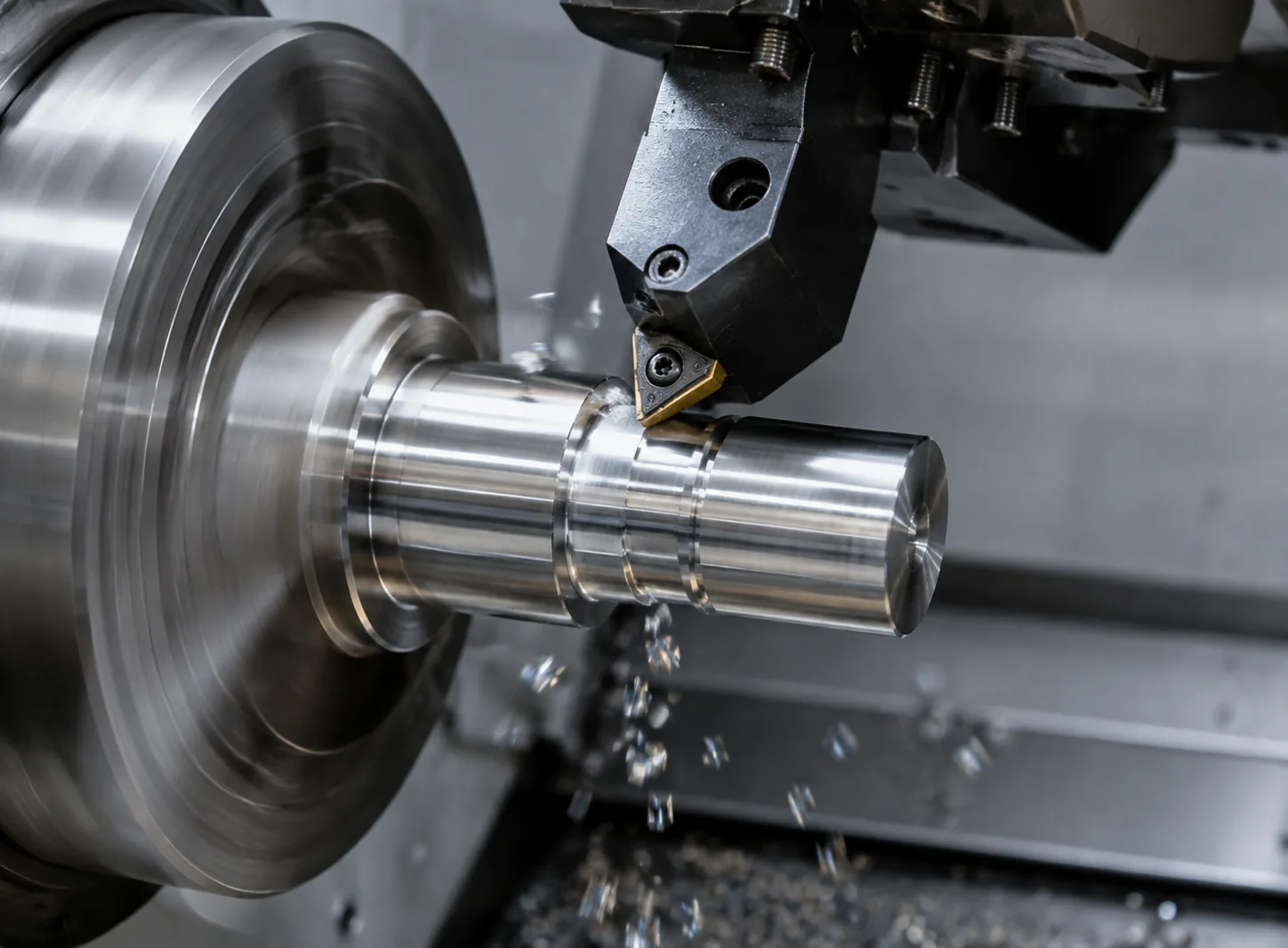
The lead time is lost at the drawing, not at the machine
The cheapest place to shorten a schedule is the CAD file your engineer releases on Monday, because every constraint in that file becomes a task the shop has to perform, measure, or wait on later. A hole speced at a diameter we do not stock a drill or reamer for means a tool has to be sourced or ground before the part can run; a tolerance that is tighter than the function needs means an extra finish pass and an extra inspection step; a feature on the far side of the part means another time-consuming setup. None of these shows up as a line item called "delay," but together they are usually where the week goes.
The single highest-leverage move is to standardize hole sizes. On aluminum work we keep a working set of common drills and reamers on the rack, and a part that sticks to those sizes can go from raw stock to a finished bore without a tooling wait. The same logic applies to thread sizes, counterbores, and chamfer angles: the more your print matches what the shop already runs every day, the less of the schedule is spent hunting for a tool that is not there. This is not about compromising the design — it is about choosing, from a short menu of sizes that already work, the one that meets the function.
Tolerances are the second drawing-level lever. A blanket ±0.01 mm on a housing that only needs ±0.05 mm does not make the part better; it makes every feature slower to cut and slower to check. A useful habit is to ask, for each tight callout, what actually fails if the feature drifts. If the answer is "nothing the assembly cares about," the tolerance is costing schedule for no return. Fast CNC prototyping lives or dies on exactly this discipline: the first article should be specified to prove the form, not to satisfy a number copied from an older, stricter drawing.
Stock the material before you open the quote
The longest unavoidable wait on many jobs is not machining — it is material. 6061-T6 is a common alloy, but it is stocked in specific bar, plate, and extrusion sizes, and a drawing that calls for an off-list section can add a procurement cycle that no amount of shop-floor speed will recover. The fix is to design toward the stock sizes a shop keeps on hand, or to release the drawing early enough that the bar can be on the rack while the program is still being written. When the raw stock is already in the building, the clock on your order starts at the first setup, not at the supplier's next shipment.
Scheduling the material is really a scheduling-the-work question. The jobs that ship quickly are the ones where programming, fixturing, and stock prep happen in parallel instead of in a queue. A programmer can build the toolpaths from the released model while the material is being cut to length; a fixture can be designed from the datum scheme while the bar is still in transit; first-article inspection paperwork can be templated before the first part is cut. None of this is heroics — it is simply deciding the sequence of preparation up front so that no one is standing still waiting for the previous step. Buyers who send a clean, frozen drawing and answer the DFM questions in one pass tend to see the biggest compression, because the shop never has to pause to clarify a feature.
There is also a quieter win in lot sizing. A prototype run of five parts and a production run of five hundred both need one setup to prove the process; doing them as a single planned flow, rather than as two separate orders weeks apart, avoids paying the setup tax twice. When the volume is known early, the shop can choose a process path — fixture, tooling, inspection plan — that serves both, and the later batch simply repeats a proven routine.
Squeeze the machining window with fewer setups
Every time a part leaves the vise or chuck and gets re-fixtured, you pay twice: once in the handling and indication time, and again in the risk that the new setup introduces a location error that has to be measured and corrected. Reducing setups is therefore one of the most direct ways to reduce CNC lead time. On milled parts, choosing features and datums so that the part can be completed in a single workholding — often with a 3+2 or multi-sided fixture — collapses what would have been three operations into one continuous run. The part stays put, the datum stays true, and the schedule loses the gaps between setups.
On turned and turn-mill work the same idea shows up as combining operations on one machine. A shaft that needs a turned diameter, a drilled cross-hole, and a milled flat can be done in a single chucking if the process is planned that way, instead of being handed between a lathe and a mill and back. Fewer handoffs means fewer queues, fewer fixtures, and fewer chances for a part to sit waiting for the next station. The planning effort is front-loaded into the program, which is exactly where it is cheapest.
Right-first-time programming is the other half of this. A program that is simulator-verified and built around the actual stock and tooling rarely stops mid-run to fix a crash, a gouge, or a wrong offset — and a stopped run is a run that has lost its place in the queue. In-process checks at the natural break points (after the first feature, after the critical bore) catch drift early, so a correction is a small adjustment rather than a scrapped part that has to be remade from raw stock. The goal is not to machine fast; it is to machine once.
| Design or process decision | What it adds to the schedule | Typical schedule effect | How to avoid it |
|---|---|---|---|
| Non-standard hole diameter | Tool sourcing or grinding before the run | Often a few days of wait | Pick from the shop's stocked drill/reamer list |
| Tolerance tighter than the function | Slower finish pass and extra inspection | Adds touch time on every feature | Tighten only the features that mate or seal |
| Feature on the far side of the part | An extra setup and re-indication | One more queue and risk step | Consolidate to one workholding where possible |
| Off-list raw stock section | Material procurement cycle | Can dominate the whole lead time | Design toward stock sizes or release early |
| Finish booked after machining | Anodizing slot wait at the end | Frequently the long pole | Reserve the finishing slot up front |
| Drawing released in stages | Clarification pauses mid-plan | Stops the parallel prep | Send a frozen print and answer DFM in one pass |
Pre-book the anodizing before the saw starts
For a shop that machines and finishes aluminum in-house, the anodizing line is often the longest single pole in the schedule — and it is the one most often left until the parts are already done. By then the convenient slot is gone, and the choice is between waiting for the next batch or paying to jump the queue. The discipline that avoids this is simple: treat the anodizing booking as part of releasing the job, not as a step that follows machining. When the finish slot is reserved against the expected completion date, the parts move straight from the last op into the tank instead of sitting in a basket awaiting a gap.
Several choices around the finish itself also protect the date. Standard clear and a few common colors run on a predictable cadence; a one-off custom shade or a tight color match is a different conversation and a different wait. Masking requirements — which threads, bores, or faces must stay un-anodized — should be decided on the drawing, because late masking changes mean the parts come back, get reworked, and lose their place. Even the question of whether the part needs Type II or Type III, and to what film thickness, changes how the line is loaded, so stating it early lets the finisher plan the rack rather than improvise one.
Batching helps too. A small prototype lot that can ride along with a larger anodizing load of similar parts usually moves faster than the same lot booked alone, because it fills a rack that was already going to run. This is the finishing equivalent of the lot-sizing point earlier: planning the anodizing as one shared, pre-booked operation — not as a separate emergency at the end — is usually what separates a job that ships on its planned date from one that slips a week for want of a tank slot.
A pre-order checklist that protects your date
None of the moves above is complicated on its own. The hard part is remembering all of them while a deadline is already pressing, which is exactly when they get skipped. The list below is the same one we walk a new order through before it enters the schedule, and it is the fastest way to find the days you can recover without a rush fee.
- Standardize every hole and thread. Check each diameter against the stocked drill and reamer list; substitute a standard size wherever the function allows.
- Relax tolerances that the function does not need. Tighten only the features that locate, seal, or mate. Let the rest ride on the general block.
- Design for one setup. Choose datums and feature locations so the part finishes in a single workholding, not three.
- Release a frozen drawing. Answer the DFM questions in one pass so programming, fixturing, and stock prep can run in parallel.
- Match the raw stock to inventory. Specify a section the shop keeps on hand, or release early enough to bring it in while the program is written.
- Book the anodizing up front. Reserve the finishing slot against the expected completion date, with masking and color already decided.
- State the finish spec early. Type II vs Type III, film thickness, and color should be on the print, not a phone call after machining.
- Plan prototype and production as one flow. When the volume is known, choose tooling and fixtures that serve both and avoid paying the setup twice.
- Verify the program before the run. A simulator-checked toolpath and in-process checks at break points keep the part moving instead of stopping to be fixed.
- Send it for a DFM read before you commit. A short engineering review catches the schedule leaks while they are still free to close.
"A finishing slot that is reserved before the first chip is cut is worth more than any rush fee paid after the parts are done. The shops that ship fast are not the ones that panic well — they are the ones that decided the anodizing load while the raw stock was still on the saw."
CNC turnaround time is mostly a planning problem wearing a machining costume. The part that arrives as a frozen, standard-friendly drawing, on stock we already hold, with its finish slot already booked, will almost always beat the part that is perfect on paper but arrives late, custom in every hole, and surprised that anodizing takes longer than the cut. You do not get there by paying more — you get there by deciding the schedule at the drawing, in parallel, before the machine is even powered up. Do that, and fast CNC prototyping stops being a premium service and becomes the default way the job runs.
If your next order has a date attached to it, send the drawing over for a DFM read and we will flag the schedule leaks before they cost you the week — see how our in-house anodizing keeps the finishing step on the same calendar as the machining.